.png)
 10 hours ago
3
10 hours ago
3
Geeta Pandey, Anahita Sachdev & Vishnukant TiwariDelhi & Madhya Pradesh

 @aashihoops/Instagram
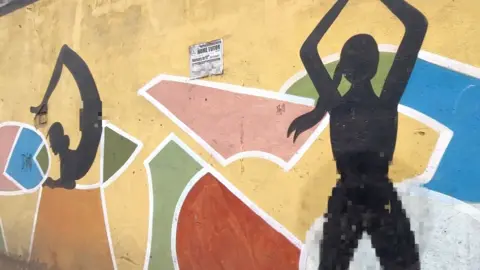
The mural in India's Gwalior city was defaced by unidentified persons
A recent viral video of defaced artwork on a public wall in the central Indian city of Gwalior has led to outrage on social media and among activists.
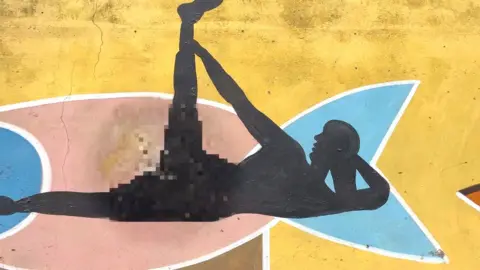
The video, shared by a school student on Instagram last week, showed scratches and marks made around where the genitals would be on female silhouettes doing yoga.
In her post, the teenager said she passed the murals daily and seeing the black silhouettes defaced with white markings filled her "with anger and disgust".
"This is not harmless damage. This is cheap thinking, dirty mentality, and deep disrespect. It's shameful, embarrassing, and extremely disappointing that even a woman's painting isn't safe from such sick minds," she wrote.
The video of the defaced artwork sparked anger on social media, with many saying that the sight made them "uneasy" and that "women are not safe even in graffiti".
The act of vandalism also made headlines, with the media describing it as "shameful", "embarrassing", "sick" and "an attack on women's dignity".
This week, city authorities stepped in and whitewashed the wall, but activists say that will not solve the actual problem - the mindset that led to sexualisation of even female silhouettes.
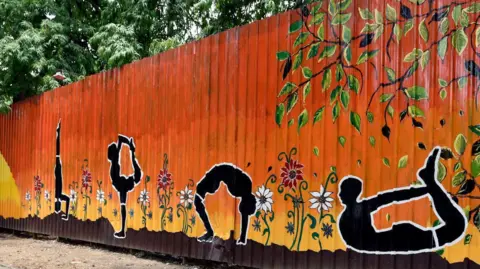
In recent years, India has been promoting the ancient practice of yoga by holding an annual global yoga day and artful graffiti of yoga poses have been painted across cities, including in the capital Delhi.
The brightly coloured murals in Gwalior in Madhya Pradesh state were part of a project to beautify the city.
 @aashihoops/Instagram
The viral video showing the defaced mural generated shock and outrage among Indian social media users
After the student's video went viral, a local resident tried fixing the problem.
Lokendra Singh, a college student and a social media influencer, painted over the obscene markings with black paint.
"It requires a lot of courage to make something right, especially in a public space. But I thought someone has to do it," he told the BBC.
It was after his video also went viral that city authorities stepped in.
Gwalior Municipal Corporation spokesman Umesh Gupta blamed the defacing on "some miscreants" and said they had not been identified, since there were no CCTV cameras around these walls.
He said they had sent workers to whitewash the wall.
"Whitewashing is done in some places and the work is going on in a few other places where paintings have been defaced. Once all the defaced walls are whitewashed, we will get new paintings made," Gupta said.
It is not clear if the restoration would bring back the original artwork. The civic authority has announced a "street wall painting competition" for Sunday, inviting artists to come help beautify the city. The themes it has listed include cleanliness, environmental issues, water conservation, perils of tobacco use and how to be a responsible citizen. It does not mention yoga.
The whitewashing of the wall has also been questioned by some who pointed out that maybe this approach was missing the point.
The answer, they suggested, was not to paint over the problem but to address the mentality that caused it in the first place.
The teenager who first shared the video also told the Times of India newspaper that "the wall can be fixed and repainted, but what about the mentality of the people who are objectifying even a black painting of a woman"?
 Hindustan Times via Getty
Graffiti and murals with yoga motifs are found in many Indian cities, including capital Delhi
That is a much harder project to undertake, says Kalpana Viswanath, co-founder of Safetipin, a social organisation working to make public spaces safe and inclusive for women.
And the only way it can be done is by engaging with young men - to make them understand that what they think is harmless fun is harming women.
"Even if we believe that the vandals in Gwalior were a group of men having fun and choose not to ascribe deeper meaning, it's a form of sexual harassment, whether it's done to women or to art in public places."
Artwork that shows women's body or genitalia attracts attention not just in India.
Last year, a German women's rights charity Terre Des Femmes pointed out that bronze statues of women around the world had discoloured breasts from being touched and rubbed.
- A tiny tool Indian women use to fight sexual harassment
- Rising crimes against Indian women in five charts
- Stewards brought in to protect 'groped' Molly Malone statue
There have also been instances where feminists themselves have found an artwork offensive and protested against the male gaze. In a well-reported case last year, a group of feminist artist-activists vandalised a 19th-Century painting of a woman's vulva by French artist Gustave Courbet, calling it misogynistic.
Viswanath says in India, where men dominate public spaces and women's access to them is "so limited and fragile", what happened in Gwalior "adds to the list of things that further restrict our access".
"There are so many things that hold us back. Every time something bad happens, families and friends force women to retreat. Our freedoms can be taken away so easily."
But in all of this, she says, there is a silver lining.
"It's good to see young women refusing to cower down. What is most heartening is that this and other similar challenges are coming from smaller cities and towns. For me they are representative of the active voice of young women speaking against patriarchy.
"And the courage they are displaying is remarkable."








 English (US) ·