.png)
 1 day ago
4
1 day ago
4
A wave of protests sparked by Iran's failing economy has entered its ninth day, as President Donald Trump renewed his threat of US intervention.
On Sunday, videos published online showed demonstrations in Tehran, as well as Fars, Ilam, North Khorasan and Semnan provinces.
Human rights activists said protests had taken place in 26 of the country's 31 provinces since last week, and that at least 19 protesters and one member of the security forces had been killed.
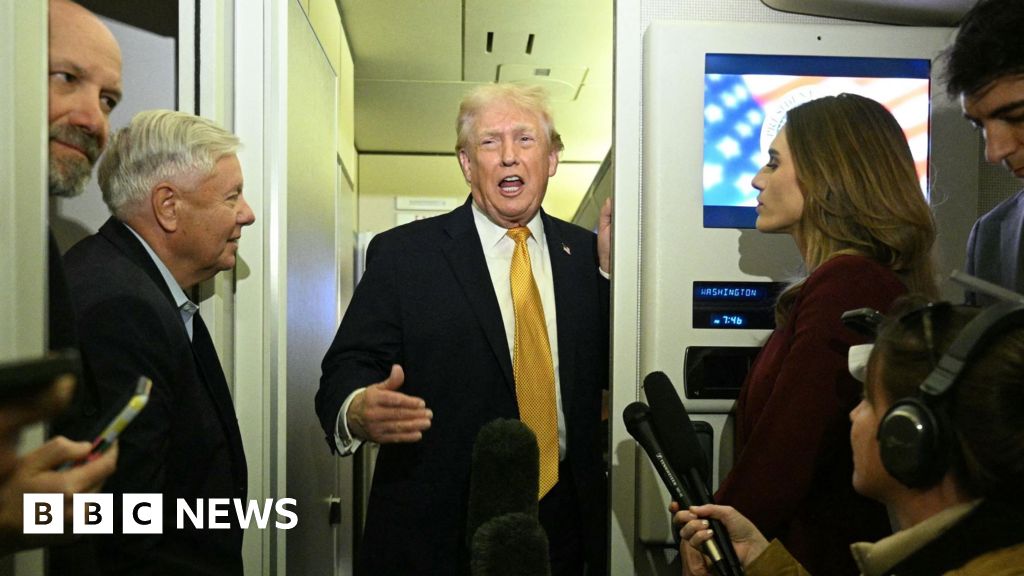
Trump warned overnight that Iranian authorities would be "hit very hard" if more protesters died.
"We're watching it very closely. If they start killing people like they have in the past, I think they're going to get hit very hard by the United States," he told reporters on Air Force One.
On Monday morning, the speaker of Iran's parliament said the protesters' "legitimate demands" should be heard and used as the basis for change.
But Mohammad Baqer Qalibaf added that any foreign agents and opponents of the establishment attempting to exploit the protests would be "confronted effectively".
His comments echoed those of Iran's Supreme Leader, Ayatollah Ali Khamenei, who has declared that "rioters should be put in their place".
The Iranian foreign ministry's spokesman also accused Israel of seeking to "undermine our national unity", after Prime Minister Benjamin Netanyahu expressed his government's "solidarity with the struggle of the Iranian people" on Sunday.
Esmail Baqai told a news conference that the statements by Netanyahu and "certain radical American officials" were "nothing more than incitement to violence".
Iran and Israel fought a 12-day war last June, during which Israeli and US jets bombed key Iranian nuclear facilities.
The latest protests in Iran began when shopkeepers took to the streets of Tehran on 28 December to express their anger at another sharp fall in the value of the Iranian currency against the US dollar. The rial has sunk to a record low and inflation has risen to 40% as sanctions over Iran's nuclear programme squeeze the economy.
University students soon joined the protests and they began spreading to other cities.
On Monday, footage posted on social media appeared to show a protest in the city of Yasuj, south-western Iran, according to BBC Persian. A crowd of men and women could be heard chanting "Freedom, freedom, freedom".
Videos obtained by BBC Persian on Sunday night appeared to show several dozen protesters marching down a street in the city of Sari, north of Tehran.
They can be heard chanting slogans including "Death to the dictator" - a reference to Khamenei, who has ultimate power in the country - and "Pahlavi is coming back" - a reference to Reza Pahlavi, the exiled son of the late shah.
In another clip, a number of people are seen fleeing amid the sound of gunfire.
BBC Persian said there were also protests in the districts of Ilam, Arak, Hamedan, Amol, Lahijan, Kermanshah, Malekshahi, Semnan and Noorabad on Sunday evening.
Another video purportedly showed security forces storming a hospital in the western city of Ilam, where a human rights activist said wounded protesters were sheltering.
The protests have been the most widespread since an uprising in 2022 sparked by the death in custody of Mahsa Amini, a young Kurdish woman who was detained by morality police for allegedly not wearing her veil properly. Hundreds of people were killed and thousands detained in a violent crackdown by security forces.


 English (US) ·