.png)
 22 hours ago
5
22 hours ago
5
Karnie SharpBBC Focus on Africa, South Africa's west coast

 BBC
BBC
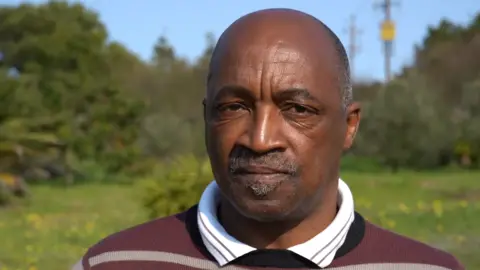
Martinus Fredericks is fighting to get the land back for his Nama people
There is a disturbing contrast along South Africa's remote west coast.
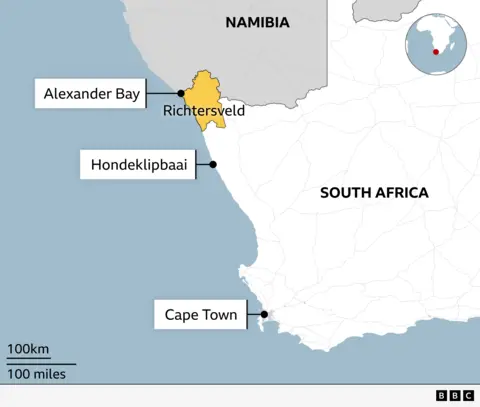
The 800km (500 mile)-journey north from Cape Town starts with views of outstanding natural beauty which as the long road rolls on, and the northern border approaches, dissolve into a pockmarked lunar-like landscape.
And the scars left by a lucrative diamond-mining industry are not just physical.
The impoverished local Nama community living amid the environmental degradation in the far north-west of South Africa – also known as Namaqualand - wonder what has happened to the riches their land has yielded.
Some of the hundreds of millions earned went on to build the country, but not much, it seems, stayed within the area.
The Nama, who straddle South Africa and Namibia, are descended from the indigenous nomadic peoples – the Khoi and the San – seen as the original human inhabitants of this part of the world.
Despite winning a legal battle over land and mining rights more than two decades ago in Richtersveld, which is part of Namaqualand, many in the community argue that they are yet to see any benefit.
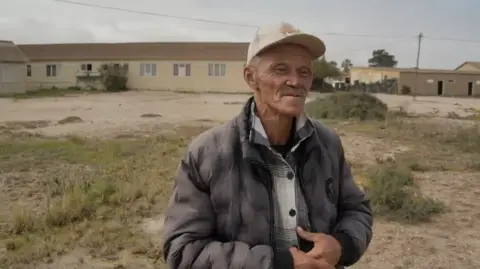
Andries Joseph once worked in the diamond industry in Richtersveld, which is now in decline
Standing amid the wrecked empty shell of a former mineworks in the coastal border town of Alexander Bay, Andries Josephs, who worked here two decades ago before he was laid off, shakes his head.
"There's no work, that's the problem. The people have stagnated and everything has gone backwards. The buildings have collapsed. Unemployment is sky-high," he says.
The diamond industry in this part of the region has declined in recent years, as most of the gems on the land are thought to have been found, leaving a trail of economic and social problems.
About a kilometre from this derelict mine is a residential area of a few houses, a broken-down church building and a hospital with some damaged windows, offering basic services.
The local authority's development plan describes "dilapidated" water and electricity infrastructure as well as poor roads which affect access to things such as healthcare.
A century ago, the discovery by prospectors of precious stones south of the Orange River, which now forms part of South Africa's border with Namibia, led to a diamond rush that changed the land forever.
But the Nama already knew of the gems.
"In our family, they used to teach the children to count with diamonds," says Martinus Fredericks.
In 2012, Nama elders appointed him as their leader in South Africa. The 60-year-old says they urged him to fight for the return of their ancestral lands.

Many of the abandoned mine buildings on the coast in Richetersveld are still standing
The Nama were once herders and traders until the European "settlers came and interrupted their way of life", according to Mr Fredericks.
The area where they lived was annexed in the mid-19th Century by the Cape Colony – part of what is now South Africa - and then, after diamonds were found in the 1920s, the Nama were cleared from land around the Orange River.
Nothing changed throughout the years of the racist apartheid system, or after the first democratic elections and the end of white-minority rule in 1994.
The new African National Congress-led government maintained the earlier position that the greater good was served by sharing the diamond wealth generated in these parts with the rest of the country.
The Nama were not happy and that disquiet continues to this day.
"You go to an area like the Richtersveld… you see how destitute the people are," Mr Fredericks says.
"They are unemployed. They live from hand to mouth, and then there's no real prospects.
"I'm not against development, but it must be to the extent where the community benefits as a partner."
Things should be different.
After a five-year legal battle with the state and the state-owned mining company, Alexkor, that ended up in the country's highest court, judges ruled in the Nama community's favour in 2003.
The Constitutional Court said the Nama had an inalienable right to their ancestral land and the rights to the minerals there.
However, four years later, Alexkor secured a deal with the Richtersveld Communal Property Association (CPA), which purportedly represented the Nama, that gave the company 51% of the mineral rights while 49% went to the community and an entity called the Richtersveld Mining Company.
But Mr Fredericks argues that the CPA did not represent the Nama and the agreement was made without the consent of the wider community. He alleges that 20 years on they are yet to profit from the deal, or from any wealth generated over the decades despite the Constitutional Court ruling.
Alexkor disputes this, saying in a statement to the BBC that it was "incorrect to state that the community has not benefited from the land claim".
It said Alexkor had paid 190m rand ($11m; £8.4m) "as reparation" to the Richtersveld Investment Holding Company (RIHC) over a period of three years, as well as 50m rand ($2.9m) as a development grant.
But the chairperson of Alexkor's board of directors, Dineo Peta, who took over earlier this year, acknowledged that the company was "not oblivious to the fact that the community has not received the full economic benefit of the operations". In an interview with the BBC she blamed that on "maladministration and malfeasance within Alexkor".
The previous management was subject to an investigation by a special commission into what was known as "state capture". The commission's 2022 report found that there had been corruption – those findings are currently under investigation but have not resulted in any convictions.
The issue of what has happened to the money handed over to the CPA was raised at a recent parliamentary hearing.
One lawmaker, Bino Farmer, said that during a briefing, the Select Committee on Agriculture, Land Reform and Mineral Resources heard from the department of rural development that the CPA was "dysfunctional".
He added that "it also came to light that over 300m rand ($17.6m) rand has been paid over by the department and yet the people of the community did not receive anything".
The CPA was not present at the hearing but the select committee's chairperson said that it had "expressed dissatisfaction, stating that relevant national departments had not adequately supported the implementation of the [Constitutional] Court order".
The BBC contacted the CPA on several occasions in an effort to understand what had happened to the money but has not received a response.
"[We] should have been in a much better position because we are the original custodians of the land," Mr Fredericks says.
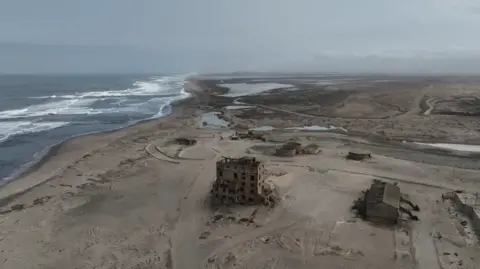
The diamond mining industry has left its mark on South Africa's north-western coastline
Apart from the money, the community leader has another concern: the environment.
"Big companies come in, they rip up the land, they take whatever they can, and they just move off without doing the rehabilitation, leaving the receiving community to deal with the after-effects of their mining," he alleges.
"The Nama people used to mine themselves, but they've done it sustainably, they knew how to use resources from the land but also how to fix the land after using it."
The damage left behind by commercial mining is hard to miss.
Some mines remain abandoned, and there is little sign of rehabilitation.
Instead, there was clear evidence of extraction, where the earth had been dug up, leaving behind an unsightly landscape.
A mine in Hondeklipbaai, once owned by the mining giant, Trans Hex, looked abandoned.
This is not part of the Richtersveld area but is still considered to be Nama land.
In a letter to the BBC, Trans Hex said it had sold the site five years ago, but while it "was the holder of the mining right it complied with its legal obligations including to make full financial provision for the rehabilitation of the mining areas".
But now that it has sold the site on, Trans Hex is no longer responsible for the rehabilitation, it added.
Another mining giant, De Beers, has sold its interests in the mines on the west coast and says that it passed on responsibility for repairing the environment.
But in an email to the BBC it did say that "as part of the sale agreement in 2023 with Kleinzee Holdings, De Beers Consolidated Mines committed 50m rand ($3m) to support rehabilitation work in the area".
There are now concerns that the environmental damage could go further south as mining companies slowly edge their way down the coast.
The BBC asked the department of forestry, fisheries and the environment for a response to the claims that many mining companies were not sufficiently rehabilitating land they mined on.
Dion George, who was the minister until last month, said he was unavailable for comment adding that communicating via the media was "not helpful and does not lead to progress".
The new minister, Willie Aucamp, in place for just under a month, was not in a position to comment yet.
But Mr Fredericks is clear what should happen next.
"The government should return what is ours," he says.
To change things he has begun legal action against the CPA, the group that was supposed to run things on behalf of his community, saying that it was not properly constituted.
"A Nama people cannot be a Nama people without control of Nama land. A Nama person cannot be separated from Nama land because of the intrinsic link between the person and the land."
 Getty Images/BBC








 English (US) ·