.png)
 2 hours ago
1
2 hours ago
1

 Graham Huntley
Mystery has surrounded where the ancient skeleton is from
Scientists have shed light on the true origins of the so-called "first black Briton".
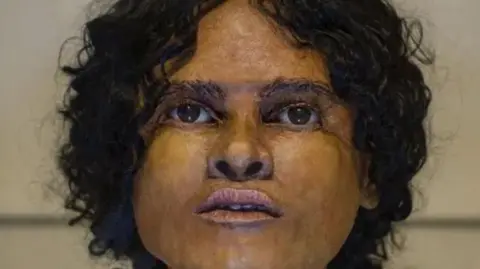
The skeletal remains - dating from Roman times - were previously thought to belong to a woman from the sub-Saharan region.
This had led her to be dubbed "one of the earliest Africans in Britain".
But scientists have now said they cannot find DNA evidence that indicates she had recent ancestry from Africa.
They detailed in a paper published online on Wednesday that she actually had a strong genetic similarity to individuals from rural Britain.
She likely had blue eyes, between pale and dark skin and light hair, scientists added.
A craniofacial reconstruction of the ancient skeleton had previously depicted her as having curly black hair, brown eyes and dark skin.
'Beachy Head Lady'
The skeleton was first uncovered in 2012 in a box in the basement of Eastbourne Town Hall in East Sussex.
The only information on the remains was a label saying 'Beachy Head (1959)' - gaining her the moniker the "Beachy Head Lady" after the beauty spot.
Multiple attempts to establish her geographical origins and ancestry were made afterwards.
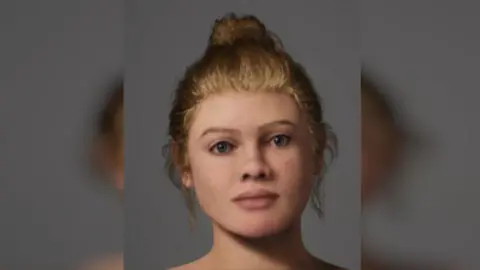 Face Lab/Liverpool John Moores University
A computer-generated image of how the "Beachy Head Lady" may have looked
The initial assessment that suggested she was of recent sub-Saharan origin was originally based on analysis of her skull in 2013, scientists said.
"The discovery of the 'first black Briton known to us' gained traction across several media outlets, non-fiction books, educational resources and academic publications," they wrote in the paper.
However, this interpretation began to shift, scientists added.
Other scientists later suggested the Beachy Head Lady may have grown up around Eastbourne, but been born in Cyprus.
"Whilst these preliminary results were not published in a scientific journal, they were subsequently reported in the media," the paper's authors said.
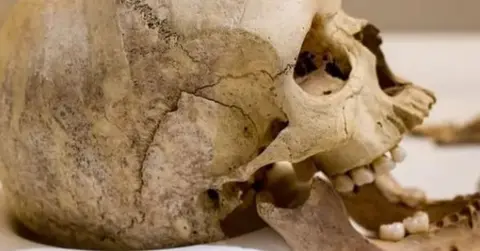 Graham Huntley
Radiocarbon dating suggests her Skeleton is from between 129 and 311 AD
Scientists' latest discovery is based on "high quality" DNA data made possible by recent advances in science and technology.
The skeleton is radiocarbon dated to between 129 and 311 AD.
The Beachy Head Lady is believed to have been aged between 18 and 25 when she died and was an estimated 5ft (1.52m) tall.
The scientists have said they cannot determine her cause of death.
They cited evidence that fish had been a greater component of her diet, consistent with living on the coast.
The paper - titled 'Beachy Head Woman: clarifying her origins using a multiproxy anthropological and biomolecular approach' - was published in the Journal of Archaeological Science.
It was authored by a team from the Natural History Museum, University College London, Heritage Eastbourne, University of Reading and Liverpool John Moores University.






 English (US) ·