.png)
 20 hours ago
6
20 hours ago
6

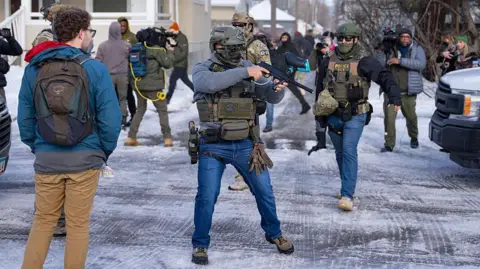 Getty Images
An officer with US Immigration and Customs Enforcement (right) and another federal officer holding a crowd control device (center) stand at a Minneapolis intersection where protesters had gathered after the death of Renee Good.
The fatal shooting of 37-year-old Renee Nicole Good in Minneapolis has sparked protests and placed increased scrutiny on the US Immigration and Customs Enforcement agency (ICE).
ICE has made thousands of arrests since Trump returned to the White House, often in public settings.
Those actions have increasingly brought its agents into communities across the country, leading to resistance from some local residents who oppose their operations.
What is ICE and when was it formed?
ICE is taking the lead in carrying out the Trump administration's mass deportation initiative, which was a central promise of his election campaign.
President Donald Trump has significantly expanded ICE, its budget, and its mission since returning to the White House. The agency enforces immigration laws and conducts investigations into undocumented immigration. It also plays a role in removing undocumented immigrants from the US.
ICE was formed as part of the Homeland Security Act of 2002, a response to the terror attacks on 11 September 2001. The legislation created the Department of Homeland Security (DHS), with ICE as one of its subsidiary agencies.
What powers do ICE agents have to arrest people?
ICE sees its mission as encompassing both public safety and national security. However, their powers are different than the average local police department in the US.
Its agents have the power to stop, detain, and arrest people they suspect of being in the US illegally. But critically, they do not have the power to arrest US citizens except in limited circumstances, such as if a person interferes with an arrest or assaults an officer.
Despite this, according to news organisation ProPublica, there were more than 170 incidents during the first nine months of Trump's presidency where federal agents held American citizens against their will.
These cases included Americans they had suspected of being undocumented immigrants.
 Getty Images
An ICE officer shot Renee Good while she was driving a car
What powers does ICE have to use force?
ICE's use of force actions are governed by a combination of the US Constitution, US law and the Department of Homeland Security's own policy guidelines.
Under the Constitution, law enforcement "can only use deadly force if the person poses a serious danger to them or other people, or the person has committed a violent crime," said Chris Slobogin, Director of the Criminal Justice Program at Vanderbilt University Law School.
But the Supreme Court has historically granted broad leniency to officers making in-the-moment decisions without the benefit of hindsight.
A DHS policy memo from 2023 states that federal law enforcement "may use deadly force only when necessary," when an officer "has a reasonable belief that the subject of such force poses an imminent threat of death or serious bodily injury" to himself or another person.
Where does ICE operate?
Typically, ICE operates inside the US, with some staffing abroad. It's sister agency, US Customs and Border Protection, technically patrols the US borders.
But those roles have become increasingly blurred, as the Trump administration pulled agents from a range of federal law enforcement agencies to participate in immigration enforcement. Border Patrol officers increasingly operate within the US, taking part in raids with ICE.
ICE and other agencies have deployed hundreds of officers to cities like Los Angeles, Chicago, and now Minneapolis, in partnership with other federal law enforcement agencies. The Associated Press reported as many as 2,000 federal officers will deploy to Minneapolis as part of the latest operation.
What happens to people who are detained by ICE?
The scale of Trump-era deportations have been significant. The administration said it had deported 605,000 people between 20 January - 10 December 2025. It also said 1.9 million immigrants had "voluntarily self-deported", following an aggressive public awareness campaign encouraging people to leave the country on their own to avoid arrest or detention.
An immigrant who encounters ICE can face a variety of outcomes. Sometimes an individual is temporarily held, then released after questioning. In other circumstances, ICE will detain and transfer that person to a larger detention facility, of which there are several throughout the US. While many immigrants continue to fight for legal status while detained, if they are unsuccessful, they may ultimately be deported.
About 65,000 people were in ICE detention as of 30 November 2025, according to data obtained by the Transactional Records Access Clearinghouse's Immigration project, a compendium of government data from Syracuse University.
Immigration attorneys have told the BBC that once ICE detains an individual, it can sometimes take days for families or lawyers to find out where they are.
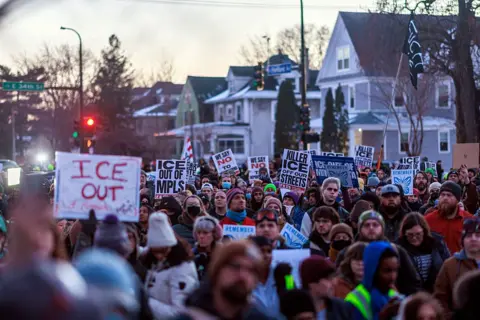 Getty Images
People demonstrate against ICE during a vigil honouring Renee Good, who was shot and killed by an immigration officer
What are the criticisms of ICE and what opposition have its agents met?
Many communities have pushed back when ICE and partner agencies like the Border Patrol carry out operations.
It is now common for residents to film ICE agents as they carry out arrests. Some encounters between ICE and the public have become aggressive or violent.
During ICE operations in Chicago, Illinois, a collective of media organisations sued the Border Patrol. They alleged agents used improper force against journalists, religious leaders and protesters. A federal judge sided with the plaintiffs, before an appeals court overturned her order.
The Minneapolis shooting is not the first time an individual has been injured by gunfire during an immigration enforcement operation. There were two incidents in Los Angeles in October where agents shot at drivers, the Los Angeles Times reported. DHS said in both instances that the drivers had threatened the officers with their vehicles.
ICE officers, and other immigration agents, have been criticised for wearing masks while carrying out their operations. DHS officials have defended the practice, saying it protects agents from doxing or harassment.
Where do Americans stand on ICE and deportations?
Americans have a complicated view of Trump's immigration enforcement plans, polling suggests.
A little more than half of Americans believe some level of deportation is necessary, an October 2025 survey from the nonpartisan Pew Research Center suggested. That's roughly the same number as Pew found the previous March.
But the same poll suggests that Americans have concerns about Trump's methods.
The poll suggests that a majority of American adults, 53%, believe the Trump administration is doing "too much" to deport undocumented immigrants. About 36% backed the approach.







 English (US) ·