.png)
 12 hours ago
4
12 hours ago
4
Aleem Maqbool,Religion editorand Catherine Wyatt,Religious Affairs producer

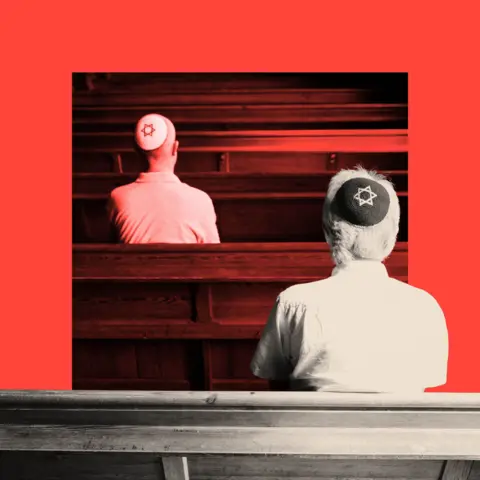 BBC
BBC
"It's been an incredibly difficult two years," says Phil Rosenberg, president of the Board of Deputies of British Jews. "I think our Jewish identity is being worn far more heavily these days given the pain of it all."
Conflict in the Middle East has, he says, had a profound impact on British Jewish society.
"The attacks of 7 October were felt very personally, not least because there were British Jews who were killed in the initial onslaught and people with British connections held hostage.
"And in the war that followed, the devastation in Gaza was very painful to watch. Then there was the vitriol that surrounded the whole conflict, and the massive rise in antisemitism culminating in deadly attacks."
The devastating shooting at Bondi Beach last weekend, which targeted the Jewish community during Hanukkah celebrations, and the attack on a Manchester synagogue on the holiest day in the Jewish calendar, Yom Kippur, together with the events in the Middle East over the past two years, have collectively had far-reaching repercussions for Britain's estimated 300,000 Jews.
 Getty Images
Naveed Akram, the surviving suspect in the mass shooting in Sydney, has been charged with 59 offences, including 15 counts of murder and one of committing a terrorist act
Since the 1967 war in the Middle East it is hard to think of such a pronounced inflection point for British Jewish society, one that has so clearly affected daily lives.
There have been shifts in how secure many feel, and how connected they feel to the rest of the community. And with it, there is also some evidence that there have been shifts in discourse about Israel - including a generational divide that is starting to become apparent among British Jews.
Opinion across the community is incredibly diverse, but these are the ways in which a range of British Jews told me they felt life had changed over the past two years.
Hate crimes and antisemitism
"There was an extent to which it felt like Jewish friends were more likely to understand," says Ben Dory, 33, who lives in London. "I have ended up making more Jewish friends and also being more involved with the Jewish community."
As well as taking a bigger role in his synagogue he has also been more active in campaigning against antisemitism. That has partly come because of the huge change in how secure he himself feels.
"I know Jewish people who, if they are going to the synagogue, will keep their kippah (skull cap) in their pocket until the moment they're through the door, and take it off the moment that they leave."
 NurPhoto via Getty Images
Ben Dory says some people hide their kippah until they are inside the synagogue due to security concerns
Following the attack in Australia last weekend, Ben told me he was "horrified, but not surprised," saying it followed a pattern of the "global frenzy of antisemitism".
"It's long been the case that gatherings related to Israel haven't felt safe. But now Jews feel they are under a constant threat, even at non-political cultural and religious gatherings," he says.
He has become more, what he calls "political," over the past two years - and more vocal and passionate in his support for Israel. To some extent it is a response that he says is driven by a rise in anti-Jewish hate.
There were 1,543 hate crimes targeted at Jewish people in England and Wales in the year to March 2023, rising to 3,282 by March 2024, according to the Home Office.
The data for the following year is incomplete. But the Community Security Trust, a group that has monitored the number of antisemitic incidents in the UK for nearly 40 years, says levels over the past two years are the highest since their records began.
"The Jewish people that I know are more than ever conscious of the need for a safe Israel in case they need to escape there," says Ben.
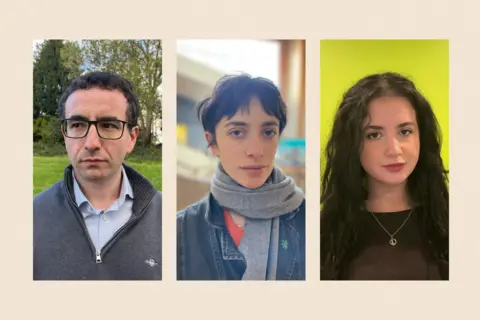
Ben Dory (left) says he was "horrified, but not surprised" by the attack at Bondi Beach. Tash Hyman (centre) says she feels less safe as a Jew in the UK today and Lavona Zarum (right) described how some of her friends turned away from her
Ever since the state of Israel's creation following the Holocaust, that notion that Israel is needed as a "safe haven" has remained for many Jews - and this has been heightened because of recent events, according to many of those I spoke to.
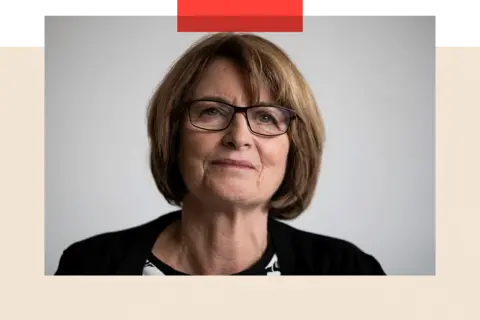
"I've never felt as vulnerable as a Jew as I do now," says Dame Louise Ellman, a former MP, "and this feeling I find is replicated among everyone I speak to in the Jewish community."
She left Labour in 2019 over concerns about antisemitism in the party, rejoining in 2021; she is also joint independent chair of the Board of Deputies, the largest body representing Jews in the UK.
Dame Louise used to attend the Heaton Park synagogue in North Manchester. She was married there and her son's Bar Mitzvah was held there.
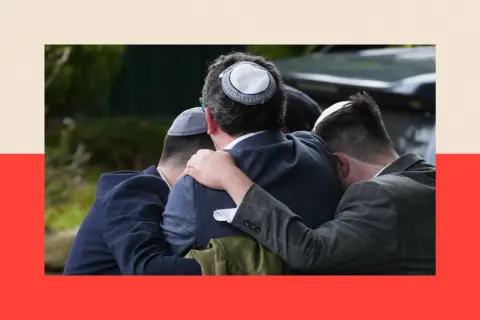
This was also where the attack in October took place, which left two victims dead and three more seriously injured, requiring hospital treatment.
Her close connection to the synagogue intensified the shock she felt. "People are increasingly concerned, feeling edgy and feeling alone," she says.
"I find this very distressing."
 Getty Images
The Heaton Park synagogue attack in October left two victims dead and three more seriously injured
All of this has, she explains, led her to a position of more staunch support for Israel. "I'm well aware that a number of people, particularly young people, are looking at this in a different way, but that is very much a minority."
One of those who has reached a very different conclusion about Israel is Tash Hyman, a 33-year-old theatre director from London.
Though the past two years have, she explains, made her feel more connected to her Jewishness - for example, she has leaned more into traditions of Jewish activism - she does not feel greater support for Israel.
"I grew up in a religious context where my Jewishness was very much entwined with the state of Israel, but I really started to interrogate that," she says. "The bottom line for me now is that the actions of the state of Israel make me feel less safe, not more safe.
"It makes me less safe in the UK because of what they are doing in Gaza." She rejects the idea that Israel is a "safe haven" for British Jews.
 AFP via Getty Images
Tash Hyman says recent years have strengthened her connection to her Jewishness, though not her support for Israel
About 1,200 people were killed when Hamas attacked Israel on 7 October 2023 and more than 250 people were taken hostage. Since then, according to Gaza's Hamas-run health ministry, more than 70,000 Palestinians have been killed by Israeli military action.
Tash says that because some assume Jews support Israel's actions, it is important that those who do not make clear that there is opposition to what Israel is doing from within the Jewish community.
Today she attends synagogue but has surrounded herself with those who are politically like-minded - pointing out that the Hamas attacks and the war in Gaza have made nuanced debate between British Jews about Israel all the more difficult.
"It does certainly feel like there's a polarising and there's a real inability to have that conversation across the divide, because the divide is so big."
Zionism: a generational divide
Data from the Institute for Jewish Policy Research (JPR), a UK think tank, gathered before the Manchester attack and published in October, suggests that there is a generational divide in opinion among British Jews when it comes to views about Israel.
The study of 4,822 British Jews over the age of 16 suggested that the overall number identifying as "Zionist" was 64%, but among the 20-30 age group, only 47% did. Meanwhile 20% of that age group describe themselves as "non Zionist" and 24% as "anti-Zionist". (It was left to respondents to decide how to interpret those labels.)
The proportion of those Jews identifying as anti-Zionist since 2022 has increased in all age groups but so too has the gap between older and younger groups. For example, 3% of 50-59 year olds surveyed in 2022 said they were anti-Zionist, a 10 point gap compared to the 20-29 age group.
By 2024, it was a 17-point gap - with 7% of 50-59 year olds saying they were anti-Zionist, compared to 24% for the younger group. (Comparable figures by age are not available longer-term.)
 AFP via Getty Image
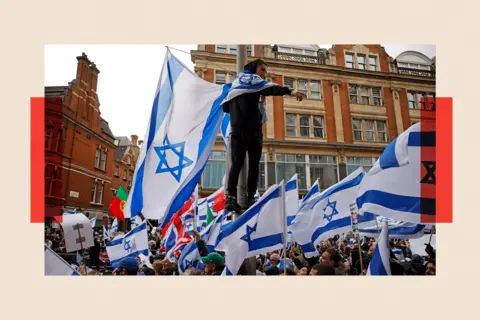
Data from the Institute for Jewish Policy Research suggests a generational divide in opinions on Israel among British Jews
Robert Cohen, a PhD student at King's College London, has done his own research into Jews in the UK who are now critical of Israel's actions in Gaza, and what led them to reach that position.
Between February 2023 and October 2024, he interviewed 21 people who took that stance and has tried to shed light on why a generational gap might be opening up.
He believes that for some young people, their stance was the result of what he described as their "British Jewish ethics" around issues such as justice and charity coming together with their "Gen Z sensibilities".
"We know Gen Z are characterised by authenticity, being super-inclusive, being very big on justice issues," he argues. "And I could see among my research cohort there was a merging of those things with the ethics of their Jewish upbringing."
Others I spoke to, including Ben Dory, suggested that a generational split over views on Israel could be associated with young people having less of a direct connection with the Holocaust and a lack of awareness of its impact.
 Getty Images
Dame Louise Ellman says recent events led her to a position of more staunch support for Israel. 'I'm well aware that a number of people, particularly young people, are looking at this in a different way,' she adds
Robert Cohen also suggests that those British Jews he interviewed who wanted to speak out against Israel's actions in Gaza often wanted to do so alongside others from the community who would best understand them, referring to the "Jewish bloc" at pro-Palestinian marches.
He also talked of the alarm some had felt at unsympathetic reaction to the Hamas attacks.
"Some were clearly disturbed by the fact that they could see a complete collapse in empathy towards the Jewish Israeli victims of what happened on 7 October."
By taking a stance that was critical of Israel, many of those he spoke to had fallen out with friends or family.
 Getty Images
Robert Cohen believes some young people's views reflect a mix of British Jewish ethics and "Gen Z sensibilities"
But over the past two years many other young British Jews became more staunchly supportive of Israel, and that also may have had an impact on relationships with those around them.
'My friend group turned away from me'
Lavona Zarum was born in Israel and brought up in London. At the time of the 7 October attacks, she was a student and had just been appointed president of the Jewish Society at the University of Aberdeen.
"I had quite a few people walk away," she recalls. "The girls in my main friend group, slowly over that summer, all turned away from me."
She recalls how isolated she felt - and how difficult she found it to talk to a lot of non-Jewish students about the way she felt about the attacks in Israel and the war that followed.
She was also offended by certain social media posts by people she knew - some were about "globalising the intifada".
"People felt very comfortable saying what they wanted, and I had been very careful not to bring it up really. I kind of retreated within myself."
Lavona is 21 now. She has since gravitated towards friends with whom she feels there is mutual respect, even if they disagree.
She also visited Israel six months after 7 October through a fellowship with the Union of Jewish Students, visiting some of the sites attacked by Hamas where she said people "spoke kindly and listened and shared ideas" in spite of some differences in opinion.
"The world was a bit more antisemitic than I had allowed myself to believe before," she adds. "But it's taught me to enter into discussions being more intentional and thoughtful, and also backing myself up."
Discord within the Board
Over the past two years, the Board of Deputies of British Jews has faced questions of their own about how to conduct debates on Israel.
Earlier this year, 36 of the board's members signed an open letter, which was published in the Financial Times, protesting against "this most extremist of Israeli governments" and its failure to free the hostages held since 7 October.
"Israel's soul is being ripped out and we… fear for the future of the Israel we love," the letter said.
Five members of the Board were suspended for instigating the letter. The Board's Constitution Committee found that they had broken a code of conduct by creating the "misleading impression that this [the letter] was an official document of the Board as a whole".
But for some, the letter represented a watershed moment where some of the conversations about Israel happening in private within the UK's Jewish community could be had in public.
Phil Rosenberg argues that there has long been healthy debate among the 300 deputies. His primary concern now is the safety of British Jews but also how the community sees itself.
"We have a whole range of activities to confront antisemitism," he says. "But we also believe that the community needs not just to be seeing itself, and to be seen, through the prism of pain.
"It already wasn't right that the only public commemoration of Jewish life in this country is Holocaust Memorial Day. And the only compulsory education is Holocaust education. Both of these things are incredibly important, but that's not the whole experience of Jews."
 PA Media
Phil Rosenberg (pictured) says one of his primary concerns is the safety of Jews
Back in May 2024 when he first became president of the board, Phil Rosenberg had talked about aiming to celebrate more the contributions made by Jews to British life. The events of the past two years have, he says, been detrimental to that.
"The war definitely has made it harder because when you open either a Jewish media publication or a national publication it's all bad news.
"Right now, as a Jew in Britain, it can feel hard to feel good about things and hard to feel positive."
As for the generational divide among British Jews about views on Israel, Robert Cohen predicts that the situation on the ground in the Middle East, and whether it results in greater rights for Palestinians, will determine whether it becomes more pronounced.
For Ben Dory, especially after the Bondi Beach and Manchester attacks, the main concern as he looks ahead is about security.
"I think that the future of Jewish people in the UK is on a real knife edge," he says.
"And how Britain as a country chooses to respond to this challenge in the very short term will be incredibly important for whether Britain in the long term can continue to be a place that Jews feel safe."

BBC InDepth is the home on the website and app for the best analysis, with fresh perspectives that challenge assumptions and deep reporting on the biggest issues of the day. You can now sign up for notifications that will alert you whenever an InDepth story is published - click here to find out how



 English (US) ·